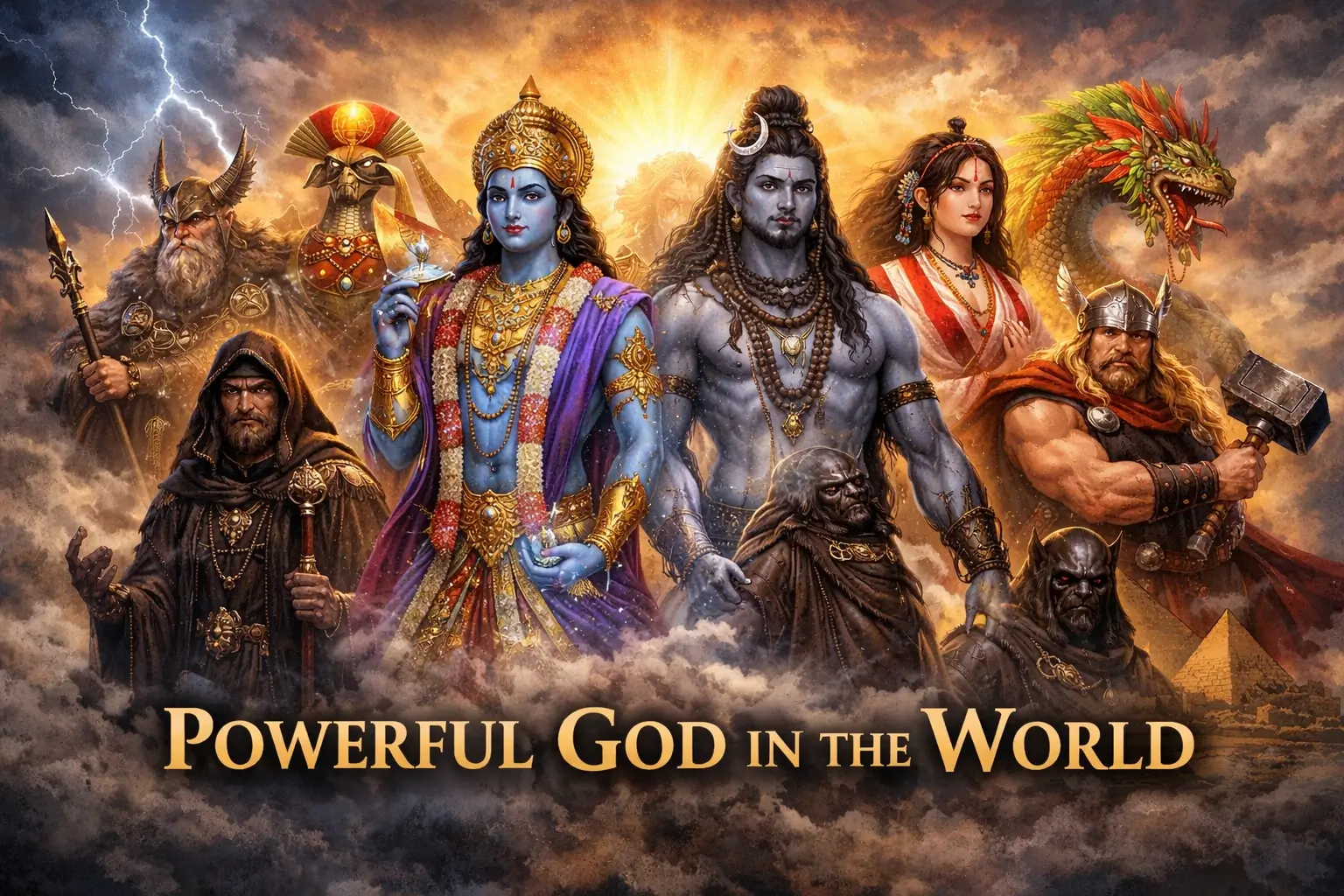
Across human history, civilizations have looked beyond the physical world to understand forces greater than themselves. Storms, creation, destruction, life, death, time, and morality were all explained through the idea of divine beings, gods whose power shaped the universe and guided human destiny. While every culture defines power differently, most agree that a “powerful god” governs cosmic order, controls nature, or influences the fate of gods and humans alike.
This blog explores ten powerful gods of the world, starting with Vishnu and Shiv, and spanning major mythologies from Asia, Europe, Africa, and the Americas. Rather than ranking them absolutely, this article looks at why each is considered powerful and what that power represents.
1. Vishnu – The Preserver of the Universe
In Hindu philosophy, power is not only about destruction or dominance, but also about balance. Vishnu is one of the most powerful gods because he preserves the cosmic order known as Dharma. Whenever chaos threatens the universe, Vishnu intervenes.
What makes Vishnu unique is his role as the protector of existence. He descends to Earth through avatars, most famously Rama and Krishna, each time restoring moral and cosmic balance. His power lies in continuity: while the universe changes, Vishnu ensures that it does not collapse into disorder.
Vishnu is often depicted resting on the cosmic serpent Shesha, floating on the ocean of creation. This imagery symbolizes infinite control over time and space. Millions of devotees worship Vishnu not just as a god, but as the sustaining force of life itself.
2. Shiv – The God of Transformation
If Vishnu preserves the universe, Shiva transforms it. Shiva is often misunderstood as merely a destroyer, but in Hindu belief, destruction is necessary for renewal. Without Shiva, creation would stagnate.
Shiva represents the ultimate paradox: he is both ascetic and householder, calm and terrifying, destroyer and benefactor. His cosmic dance, the Tandava, symbolizes the rhythm of creation, preservation, and dissolution of the universe.
Shiva’s power is not rooted in weapons or armies, but in supreme consciousness. He is the lord of time (Mahakal), meditation, and liberation. For many devotees, Shiva is the highest reality, formless, infinite, and beyond human understanding.
3. Zeus – King of the Olympian Gods
In Greek mythology, authority and command define divine power. Zeus is the ruler of Mount Olympus and the king of all gods and humans. Armed with thunderbolts, Zeus controls the sky, storms, and cosmic justice.
Zeus’s power is political as well as physical. He maintains order among the gods and punishes those who challenge divine law. His decisions influence the fate of heroes, cities, and entire civilizations.
Although known for his flaws, Zeus represents the ancient Greek idea that supreme power must enforce law and balance. His authority over gods and mortals alike makes him one of the most powerful figures in world mythology.
4. Odin – The All-Father of Norse Mythology
Power in Norse mythology is closely tied to wisdom and sacrifice. Odin, known as the All-Father, rules over Asgard but gains his power through relentless pursuit of knowledge.
Odin sacrificed one of his eyes for wisdom and hung himself on the World Tree, Yggdrasil, to gain knowledge of the runes. He is a god of war, poetry, magic, and death, commanding both warriors and scholars.
Unlike gods who rely on brute strength, Odin’s power is strategic and intellectual. He understands fate (Wyrd) and prepares for Ragnarok, the end of the world. His acceptance of destiny, even when it leads to destruction, defines a uniquely profound form of power.
5. Ra – The Sun God of Creation
In ancient Egypt, the sun was the source of all life. Ra embodied that life-giving force. As the creator god, Ra brought the universe into existence and ruled over gods, humans, and the natural order.
Each day, Ra traveled across the sky in his solar boat, bringing light and warmth. Each night, he journeyed through the underworld, battling chaos to ensure the sun would rise again. This daily cycle symbolized eternal renewal and divine responsibility.
Ra’s power lies in creation itself. Without him, there would be no life, time, or order. For thousands of years, Egyptian kings ruled as representatives of Ra, reinforcing his unmatched authority.
6. Amaterasu – Goddess of the Sun and Light
In Japanese Shinto belief, harmony and order define power. Amaterasu is the sun goddess and the most important deity in Shinto tradition.
Amaterasu’s light brings life, growth, and stability to the world. According to myth, when she withdrew into a cave, the world fell into darkness and chaos. Her return restored balance, proving that her presence alone sustains existence.
She is also believed to be the divine ancestor of Japanese emperors, linking spiritual power directly to political authority. Amaterasu’s power is gentle yet absolute, without violence, she governs the world through light and order.
7. Thor – God of Thunder and Strength
Raw physical power defines Thor, the Norse god of thunder. Wielding the mighty hammer Mjölnir, Thor protects both gods and humans from giants and cosmic threats.
Thor’s strength is unmatched, but his power also lies in reliability. Unlike Odin’s complex wisdom, Thor represents courage, loyalty, and action. He stands between chaos and order, ensuring the survival of the cosmos.
Among common people in Norse society, Thor was often more widely worshipped than Odin because he represented protection and strength in daily life.
8. Hades – Lord of the Underworld
Power over death is one of the greatest forms of authority. Hades rules the underworld and governs the souls of the dead.
Unlike many death gods, Hades is not evil. He is just, impartial, and unyielding. Once a soul enters his realm, even gods cannot easily interfere. This absolute control over the afterlife gives Hades immense power.
Hades also controls hidden wealth, precious metals beneath the earth, making him both feared and respected. His power is quiet, inevitable, and eternal.
9. Anu – The Supreme Sky God
In ancient Mesopotamia, Anu was the highest authority among the gods. As the god of the heavens, Anu represented ultimate divine legitimacy.
Kings ruled by Anu’s permission, and other gods derived their authority from him. Though not always active in myths, his power was absolute and unquestioned.
Anu’s strength lies in sovereignty itself, the kind of power that does not need constant display to be respected.
10. Quetzalcoatl – The Feathered Serpent God
In Mesoamerican belief, knowledge and creation defined divine power. Quetzalcoatl was the god of wisdom, wind, and creation.
He is credited with creating humanity and gifting them agriculture, science, and learning. Unlike many war-focused gods, Quetzalcoatl represented civilization and moral order.
His power lies in enlightenment, the ability to uplift humanity rather than dominate it.
Conclusion
There is no single “most powerful god in the world.” Power takes many forms: preservation, destruction, wisdom, light, death, strength, and creation. Vishnu and Shiva show cosmic balance, Zeus and Odin represent authority and wisdom, Ra and Amaterasu embody life-giving light, while others rule through strength, death, or knowledge.
Frequently Asked Questions (FAQs)
1. Who is the most powerful god in the world?
There is no single answer, as power depends on belief systems and cultures. In Hinduism, Vishnu and Shiva are considered supreme, while Zeus, Odin, and Ra are seen as the most powerful gods in Greek, Norse, and Egyptian mythologies.
2. Why are Vishnu and Shiva considered powerful gods?
Vishnu is powerful because he preserves the universe and restores cosmic balance through his avatars. Shiva is powerful because he controls destruction, time, and transformation, making renewal and creation possible.
3. Are powerful gods still worshipped today?
Yes, many powerful gods such as Vishnu, Shiva, and Amaterasu are still actively worshipped by millions of people around the world and remain central to living religions and cultural traditions.
4. Which mythology has the most powerful gods?
Every mythology portrays its gods as supreme within its belief system. Hindu mythology focuses on cosmic balance, Greek mythology on authority and justice, Norse mythology on wisdom and fate, and Egyptian mythology on creation and life.
5. What makes a god powerful in mythology?
A god’s power is defined by control over nature, life and death, time, creation, destruction, and influence over humans and other gods. Cultural importance and worship also play a major role.
6. Is there a difference between a creator god and a powerful god?
Yes. A creator god creates the universe, while a powerful god may preserve, destroy, rule, or guide it. Some gods, like Ra or Vishnu, can be both creators and powerful rulers.